
AI Quality Control in Food Manufacturing: What Actually Works on a Wet, Fast Production Line
Food products are irregular, lines are wet, and manual inspection doesn't scale. A practical comparison of four ways to automate visual quality control in food plants — and what to watch out for.
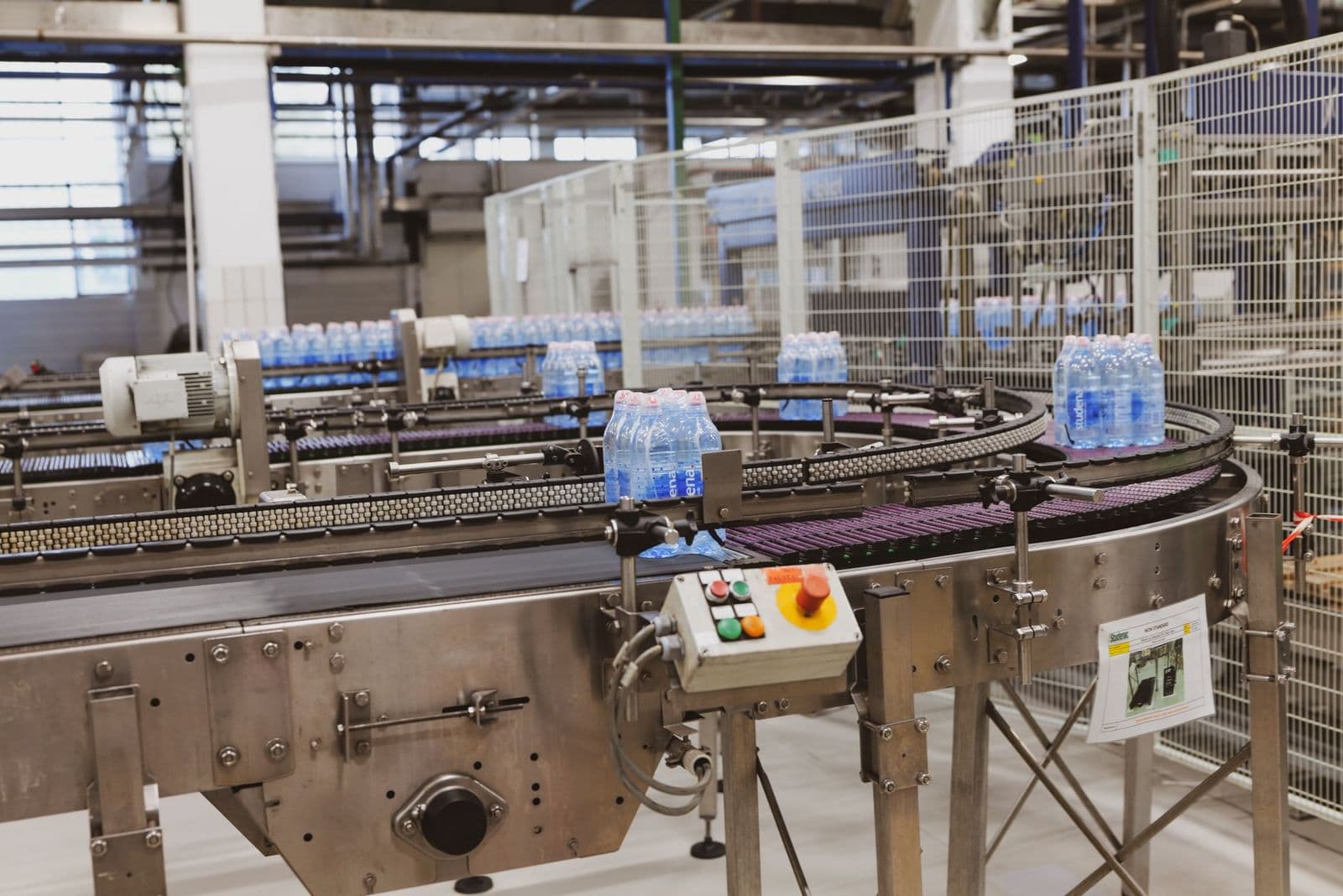
Walk through almost any food plant in Central Europe and you'll find the same picture: highly automated filling, baking, cutting and packaging — and then two or three people standing at the end of the line, visually checking products as they fly past. Quality control is very often the last non-automated step in food production. There are good reasons for that, but in 2026 they are no longer good excuses. Camera-based AI inspection has matured to the point where it handles exactly the things that used to make food inspection "impossible to automate".
Why food is the hard case for machine vision
Classic machine vision was built for automotive and electronics: rigid parts, fixed geometry, repeatable positioning. You define an edge, a diameter, a threshold — and every part either matches or it doesn't.
Food breaks every one of those assumptions:
- Natural variability. No two bread rolls, chicken fillets or blocks of cheese look the same. A rule-based system tuned tightly enough to catch defects will reject perfectly good pieces; tuned loosely enough to pass good pieces, it misses defects. Research on vision inspection of natural products calls this out explicitly — irregular, organic materials can't be analyzed with the same algorithms as synthetic goods, which is precisely why deep learning took over this space.
- Washdown environments. Food lines are sanitized daily, often with high-pressure hot water and aggressive chemicals. Any camera, lighting and controller on the line needs at least IP67, and in direct-spray zones realistically IP69K, plus stainless housings. A lot of standard vision hardware simply can't live there without expensive enclosures.
- Speed and takt. A packaging line running 60–120 pieces per minute leaves a human inspector a fraction of a second per product. Fatigue sets in fast; studies of manual visual inspection consistently show detection rates dropping well below what plants assume, especially late in a shift.
- Product changeovers. Bakeries and ready-meal producers may run dozens of SKUs on one line. An inspection system that takes a day to re-teach per product will never get used.
So the question isn't whether to automate — it's which of the available approaches actually fits a food plant. Below are the four realistic options we see in practice.
Option 1: A camera-based AI inspection subscription (e.g. Robopipe)
The newest model on the market: instead of buying a vision project, you subscribe to an inspection capability. A system like Robopipe combines an industrial AI camera in a washdown-ready housing with a controller (AI PLC) that talks to the line, and the vendor trains and maintains the detection models for your specific products.
What this looks like in practice: the camera is mounted over the conveyor, images of OK and NOK pieces are collected during normal production, a neural network is trained on them, and within days the line is rejecting defective pieces automatically — misshapen products, missing components, damaged or misprinted labels, wrong counts in a tray.
Strengths for food specifically:
- Deep-learning models handle natural shape variability by design — they learn what "normal" looks like as a distribution, not a fixed template.
- The subscription covers retraining when you launch a new product or change packaging, which is exactly where one-off projects die.
- Low upfront cost compared to a capital vision project, which matters for plants that need to prove ROI line by line.
The trade-off: you depend on the vendor for model updates, so response time and service terms belong in the contract, not in a handshake.
Option 2: Custom development with open-source models (YOLO)
If you have in-house software capability, you can build inspection yourself on open-source detection models such as YOLO, which is well proven for real-time object detection and widely published for food applications — from foreign-object detection to fruit grading and baked-goods classification.
A realistic build: industrial camera plus lighting (~in an IP67/IP69K enclosure), an edge GPU box, a labeled dataset of a few thousand images per product, and integration with the PLC for reject signals.
It can work very well — but be honest about the total cost:
- Dataset collection and labeling is 60–80 % of the effort, and it repeats for every new SKU.
- You own the whole lifecycle: camera drivers, lighting drift, model retraining, monitoring, the 2 a.m. call when the line stops.
- The engineer who built it will eventually leave. Custom vision systems without documentation and handover are a classic plant liability.
This path makes sense for large producers with a standing engineering team and many similar lines to amortize the development across. For a single line in a mid-size plant, it's usually the most expensive option once you count people's time.
Options 3 and 4: Traditional vision platforms (Keyence, Cognex)
Keyence (CV-X and similar series) and Cognex (In-Sight family) are the giants of industrial machine vision, and for good reason — in automotive, electronics and precision assembly they are excellent. Their tooling is built around exactly those industries: presence checks, gauging, assembly verification, code reading on rigid, repeatable parts.
For food, they tend to come out worst of the four options, for practical rather than ideological reasons:
- Their core toolset is rule-based. Edge detection, blob analysis and pattern matching struggle with organic variability. Both vendors have added deep-learning modules in recent years, but these are premium add-ons on top of already expensive hardware, and training is typically done by you or a paid integrator.
- They're sold as hardware projects. You buy the camera, controller and licenses upfront — often tens of thousands of euros per inspection point before integration — and every new product variant is a new engineering task.
- Washdown fit is an accessory, not a default. Suitable enclosures exist, but they add cost and complexity, because the reference customer is a dry automotive hall, not a meat plant during sanitation.
If your "food" application is actually a packaging application on rigid, printed materials — verifying date codes, reading barcodes, checking cap position — these platforms remain a solid choice. For inspecting the food itself, their strengths mostly don't apply.
What you gain beyond catching defects
A camera that sees every piece is more than a quality gate. Plants that deploy AI inspection usually discover the side benefits matter as much as the reject rate:
- Full piece counting. Exact production counts per shift and per SKU, without relying on mechanical counters or manual tallies.
- Takt monitoring. The camera timestamps every product, so you see the real line takt, micro-stoppages and slowdowns — data most food plants simply don't have today.
- Zmetkovitost trends. Instead of a weekly scrap number, you get defect rates per hour, per shift and per defect type, which points you straight at root causes (a worn cutter, a drifting oven temperature).
- Objective, documented quality. Every inspected piece can leave an image trail — valuable for audits, customer complaints and retailer disputes.
The deciding factor in food is not detection accuracy on day one — every modern system demos well. It's what happens on day 200, when you launch a new product, change a supplier's packaging, or the line gets hosed down: who retrains the model, who services the hardware, and how fast.
What to watch out for
Whichever route you choose, three questions separate successful deployments from shelfware:
- Service and response time. Who fixes the system when it starts over-rejecting on Friday night? A vision system that operators can't trust gets bypassed within weeks. Get response times in writing.
- New products mean model updates. Every new SKU, recipe tweak or packaging redesign shifts what the camera sees. Ask upfront: how many images, how much time and how much money does adding a product cost? With a subscription model this is typically included; with custom or traditional platforms it's a new mini-project.
- The environment will win. IP67 is the minimum; if the camera sits in a direct-spray sanitation zone, insist on IP69K and stainless mounting, and check the lighting too — it fails in washdown more often than the camera does.
Conclusion
Food was the last frontier for automated visual inspection because rule-based vision couldn't cope with products that are never identical. Deep learning removed that barrier; what remains is choosing a delivery model that survives real plant life — washdown, changeovers and staff turnover. Traditional platforms fit rigid packaging tasks, custom YOLO builds fit large plants with engineering teams, and subscription-based AI inspection fits plants that want the capability without owning the complexity. Start with one line, one product family and one clearly measured defect type, and let the data decide the rollout.